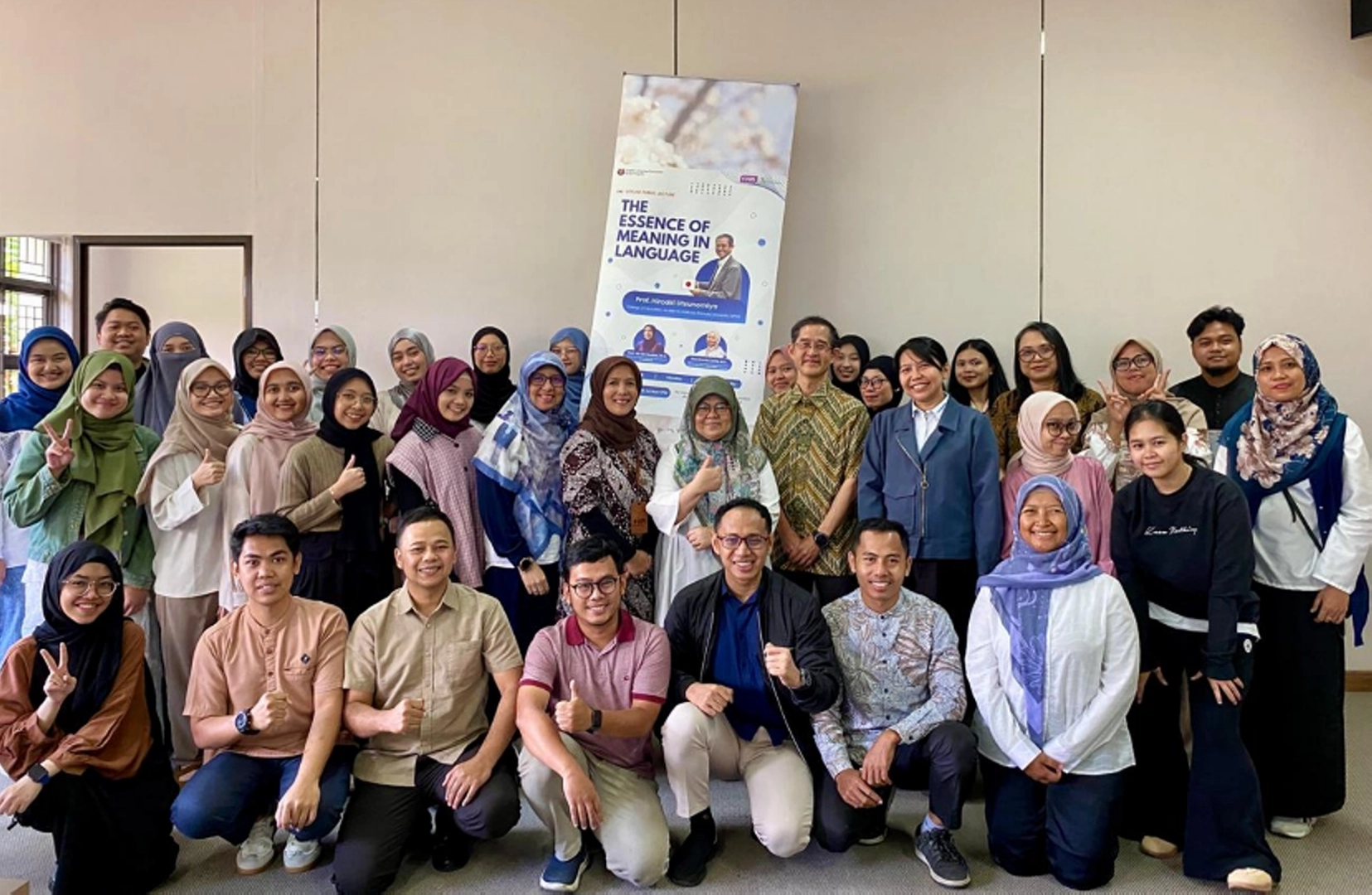
Bandung, 3 March 2026 - The English Language Education Study Program, Faculty of Language and Literature Education (FPBS), Universitas Pendidikan Indonesia (UPI) once again demonstrated its commitment to providing an international-standard academic forum. On Monday, 2 March 2026, from 09:30 to 11:00 WIB, FPBS UPI held an in-person public lecture titled “The Essence of Meaning in Language” at Meeting Room 56, 1st Floor, FPBS UPI.
The event featured an international speaker, Prof. Hiroaki Utsunomiya from the College of Education, Academic Institute, Shizuoka University. The discussion was moderated by Prof. Gin Gin Gustine and supported by Dewi Kusrini as a Japanese–Indonesian interpreter.
In his presentation, Prof. Utsunomiya emphasized that studying language is fundamentally a human effort to understand the unknown. Language not only functions as a means of communication, but also as a way for humans to observe and shape their understanding of the world.
He explained that meaning in language is neither fixed nor rigid. Meaning depends greatly on perspective and context. For instance, the definitions of “university” or “three-wheeled suitcase” may vary depending on which aspect we focus on. Likewise, the difference between the phrases “peel an apple” and “eat an apple” shows that word choice reflects different actions and purposes. Intonation and expression also play an important role in framing the meaning of an utterance.
Furthermore, participants were invited to understand the idea that meaning leads to action. A simple utterance such as “How hot!” is not merely a statement, but can serve as a cue to turn on an air conditioner. In this sense, language has the power to influence behavior and decisions.
The lecture also introduced the concept of affordances in linguistics, which views language as a dynamic environment. Within such an environment, processes such as semiotic generativity, dynamic equilibrium, and self-organization enable new meanings to emerge through interaction and shared agreement among individuals.
This public lecture represents a strategic step in broadening students’ perspectives - particularly in understanding language not only from a grammatical standpoint, but also from its philosophical and functional roles in social life. Moving forward, cross-country academic collaborations on reflective and conceptual topics such as this are considered important to further develop students’ critical thinking skills.
Through this public lecture, FPBS UPI contributed to the achievement of the Sustainable Development Goals, especially SDG 4 (Quality Education) by providing inclusive and meaningful learning, and SDG 17 (Partnerships for the Goals) through international academic cooperation. The activity also reflects UPI’s vision as a leading and outstanding higher education institution committed to cultivating academics with character, reflective capacity, and global competitiveness.