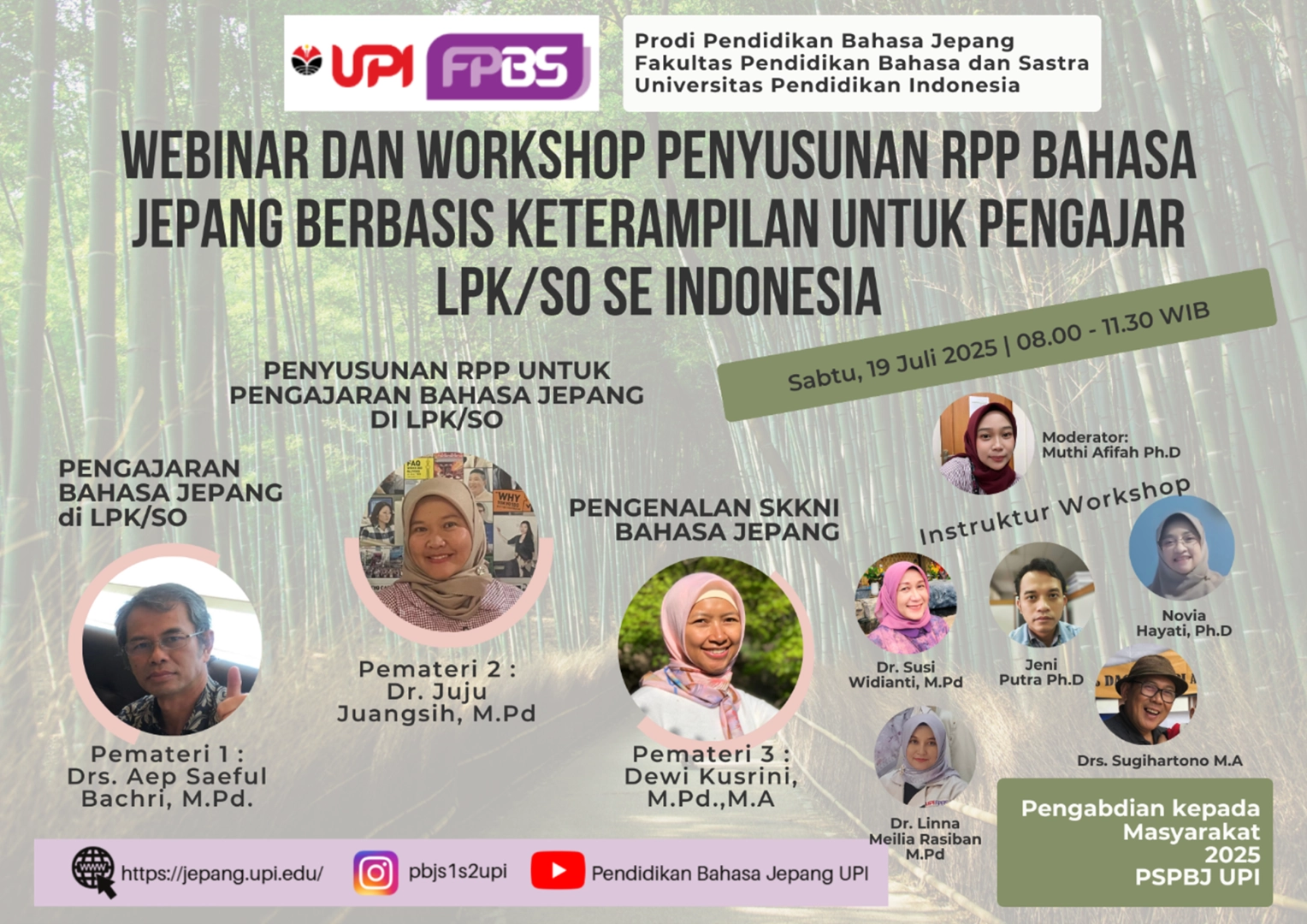
The Japanese Language Education Study Program, Faculty of Language and Literature Education (FPBS), Universitas Pendidikan Indonesia (UPI), successfully held a Webinar and Workshop on Skill-Based Japanese Lesson Plan (RPP) Development on Saturday, July 19, 2025. The event was part of the 2025 Community Service (PkM) program and was conducted online from 08:00 to 11:30 WIB.
The event was attended by a total of 126 participants, consisting of 105 teachers from LPK/SO (vocational training institutions/private organizations) across various regions in Indonesia, 16 lecturers, and 5 students from the Japanese Language Education Study Program at FPBS UPI. The main objective of this activity was to provide training on the development of skill-based Lesson Plans (RPP), especially for educators without formal educational backgrounds.
Based on feedback collected through questionnaires, most participants found the activity highly useful and relevant to their needs. Many of them admitted to not fully understanding the importance of a structured lesson plan in the teaching process. Yet, this document is essential for ensuring that teaching is organized, documented, and can be evaluated for future quality improvements.
The three main speakers of the webinar were:
- Drs. Aep Saeful Bachri, M.Pd. (Teaching Japanese at LPK/SO),
- Dr. Juju Juangsih, M.Pd. (Lesson Plan Development),
- Dewi Kusrini, M.Pd., M.A. (Introduction to the Indonesian National Work Competency Standards/SKKNI for Japanese Language).
The workshop session was facilitated by an instructional team consisting of:
- Dr. Susi Widianti, M.Pd.,
- Dr. Linna Meilia Rasiban, M.Pd.,
- Novia Hayati, Ph.D.,
- Jeni Putra, Ph.D.,
- Drs. Sugihartono, M.A.,
and moderated by Muthi Afifah, Ph.D.
Through this initiative, the Japanese Language Education Study Program at FPBS UPI contributes to achieving Sustainable Development Goal (SDG) 4: Quality Education. SDG 4 emphasizes the importance of improving teacher capacity and ensuring equal and inclusive access to training. By providing training to non-formal and vocational educators, this activity not only enhances the professional competence of teachers but also promotes a more equitable, high-quality, and sustainable education system across Indonesia.
This initiative represents a concrete step toward equitable quality education, equipping educators with the right pedagogical skills, and fostering professionalism among Japanese language teachers in the non-formal education sector. The collaborative spirit in education is expected to continue and make an even greater impact in the future.
(Dewi Kusrini)