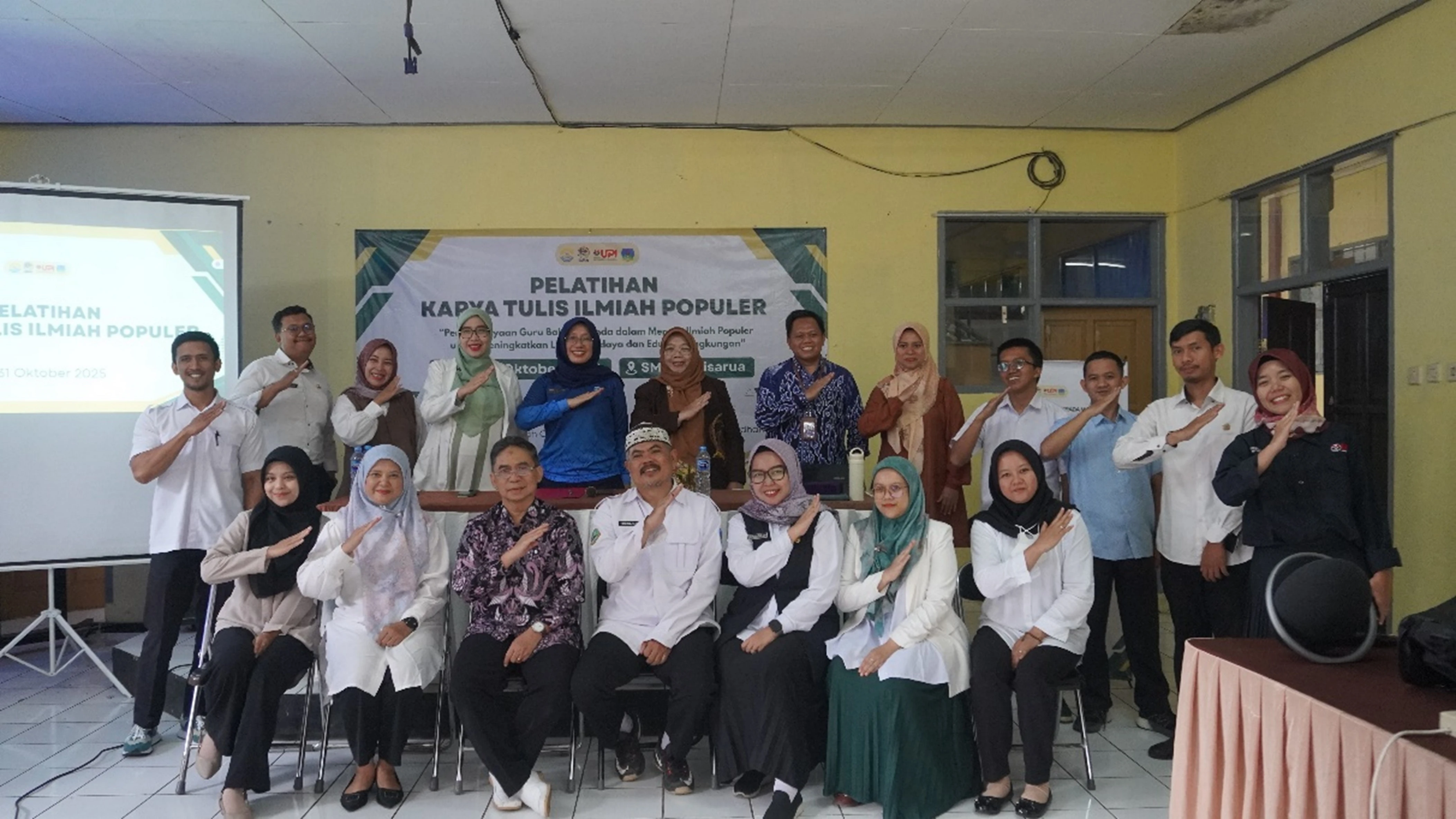
Bandung Barat, October 31, 2025 - More than 20 Sundanese language teachers from the MGMP (Subject Teachers’ Forum) of West Bandung Regency participated in a Popular Scientific Writing Workshop held at SMAN 1 Cisarua from October 29–31. The activity served as a collaborative platform for teachers to hone their skills in writing popular scientific works grounded in local culture, oriented toward environmental awareness, and adaptive to digital transformation in education and literacy.
The workshop was part of the Community Service Program (PkM) BIMA, funded by the Ministry of Education, Culture, Research, and Technology (Kemendiktisaintek) for the 2025 fiscal year, under the theme “Empowering Sundanese Language Teachers in Writing Popular Scientific Articles to Strengthen Cultural Literacy and Environmental Education.”
The program was initiated by lecturers of Universitas Pendidikan Indonesia (UPI) as a concrete contribution to enhancing teachers’ cultural literacy and fostering eco-pedagogical awareness amid rapid digital transformation.
The PkM implementation team was led by Dr. Haris Santosa Nugraha, S.Pd., M.Pd., with members Dwi Alia, S.Pd., M.Pd., and Prof. Dr. Isah Cahyani, M.Pd., along with two students, Febri Herdiyanti and Siti Humaira Ramadhani Dakir. The program was organized in collaboration with MGMP Bahasa Sunda of West Bandung Regency, chaired by Hidayat Kusdinar, S.Pd., who played an active role in coordinating participants and facilitating field activities.
According to Dr. Haris Santosa Nugraha, the initiative arose from the concern that many teachers rarely engage in writing, despite having rich experiences and ideas that could produce valuable and inspiring works.
“Sundanese language teachers possess an extraordinary wealth of cultural narratives. We aim to equip them with the skills to write popular scientific articles so they can share their ideas, experiences, and local wisdom through accessible media for the wider community,” he explained.
The PkM implementation was designed through three integrated stages combining online and offline activities. The first stage began with an online program introduction, including objectives, procedures, and a pre-test to map participants’ initial competencies. This step allowed the team to tailor the training to participants’ needs and contexts.
The second stage, conducted offline at SMAN 1 Cisarua, served as the core of the training. Participants received material on the concepts of popular scientific writing, techniques for developing ideas based on cultural literacy and environmental education, and hands-on practice in field-based writing. They also learned to use digital tools for research, editing, and visual data exploration, including SundaDigi, the online KBBI, and AI-based platforms.
The workshop emphasized practical and adaptive approaches to digital development. Participants not only practiced writing but also integrated technology into their creative process - using 360° cameras, wireless microphones, and other digital tools to document cultural and environmental phenomena more comprehensively. This innovation opened new perspectives on writing popular scientific works that are contextual, reflective, and inspiring.
On the first day, participants attended a session by Dr. R. Dian Hendrayana, S.S., M.Pd., UPI lecturer and editor of Majalah Mangle. He highlighted that writing popular scientific works is not merely about presenting facts, but also about connecting emotionally with readers through clear, engaging, and meaningful language.
“A good piece of writing is not only accurate in content but also moves readers. Sundanese teachers have that strength because they live closely with rich and inspiring cultural values,” he emphasized.
Following the session, participants conducted field observations to gather cultural and environmental data, using 360° cameras to document phenomena and enrich their narrative perspectives.
The program continued with a manuscript review session facilitated by the speakers and the PkM team. Participants received feedback on structure, argument flow, and language to make their writing more communicative and publishable. Several works were deemed ready for media publication.
The third stage, reflection and evaluation, was held online. Participants submitted their final manuscripts for revision and feedback from the PkM team and speakers. The process focused on refining content, structure, and writing style to prepare each piece for publication in local or national media outlets.
Hidayat Kusdinar, S.Pd., Chair of MGMP Bahasa Sunda West Bandung Regency, expressed his appreciation for the collaboration between UPI and Sundanese language teachers.
“This program is very valuable. Teachers have become more confident in writing and motivated to submit their work to media outlets. We hope this collaboration continues to nurture a strong literacy culture among teachers,” he said.
Participants shared that the experience was transformative, providing both theoretical understanding and direct guidance through publication.
“Writing now feels closer. Every classroom experience can become a meaningful story for many people,” said participant Tiya Komalasari, S.Pd.
This program stands as a tangible implementation of the Tri Dharma of Higher Education, particularly in community service, while supporting the Sustainable Development Goals (SDGs) - especially Goal 4 (Quality Education), Goal 11 (Sustainable Cities and Communities), and Goal 13 (Climate Action).
Through this initiative, UPI reinforces its commitment to building a culture of literacy rooted in local wisdom, environmental awareness, and human-centered digital transformation.
Contributor: Siti Humaira Ramadhani Dakir