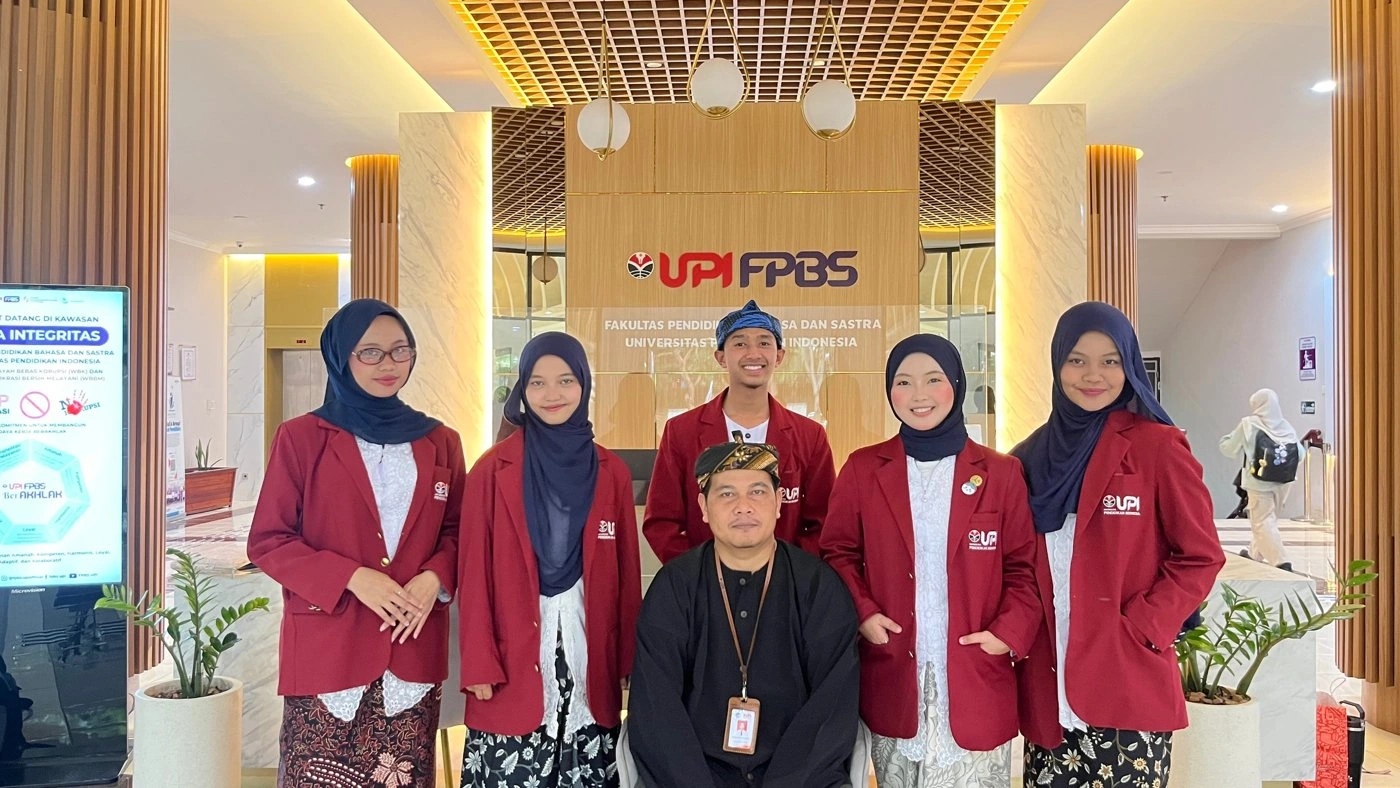
Bandung, October 23, 2026 - The Student Creativity Program in Social Sciences and Humanities Research (PKM-RSH) team from the Faculty of Language and Literature Education (FPBS), Universitas Pendidikan Indonesia (UPI), has qualified for the 39th National Student Scientific Week (PIMNAS) in 2026 (PIMNAS 39 2026), as announced on October 13, 2026, through the official Simbelmawa portal of the Ministry of Higher Education, Science, and Technology (Kemdiktisaintek). Comprising students from the Indonesian Language and Literature Study Program and the Sundanese Language Education Study Program, the team is among 420 teams that qualified for PIMNAS with a study titled “Protecting the Earth through Art: The Role of Kasepuhan Gelar Alam Rice Ritual Songs in Preserving Ecology and Food Security Based on Local Wisdom.”
The 39th PIMNAS will take place on November 2–7, 2026, at Universitas Diponegoro in Semarang. This annual national event brings together students from universities across Indonesia to present and compete with projects developed through the Student Creativity Program.
Field Research: Responding to the Environmental Crisis
The study was motivated by concerns about the environmental crisis and threats to food security. The team viewed the local wisdom of Indigenous communities as a valuable source of knowledge to investigate, particularly the rice ritual songs that remain part of life in Kasepuhan Gelar Alam. To collect data, the team conducted field research in Sirnaresmi Village, Cisolok District, Sukabumi Regency, West Java, on July 16–18, 2026. The study aims to reveal how ritual arts can sustain environmental conservation and food security.
Scientific Findings: Five Patterns of Rice Eco-Metaphors
The study’s novel finding concerns the role of rice ritual kawih (songs), rooted in three pillars: active cultural performance, indexicality, and participation. Local customary leader Ki Koyod emphasized that the arts performed in the rituals are Kahuripan arts, encompassing lisung, dogdog lojor, bende, jipeng, topeng, and angklung.
Drawing on an ecosophical perspective and Stibbe’s (2015) ecolinguistic framework, the team identified five patterns of eco-metaphors that personify rice through stages of the human life cycle. Rice is portrayed as a baby in the kawih Ayun Ambing, as a partner in Randa Ngendong, as a bride or groom in Hujan Palis, as an honored guest in Kembang Kelor, and as a divine trust in the kidung Jalan Sorompodan.
These ritual dynamics converge in the philosophy of mupusti pare, lain migusti, an ecosophical principle that guides the community to honor rice without deifying it. The findings show that the harmonious relationship between people and nature in Kasepuhan Gelar Alam is not built through rigid technical instructions, but through the development of collective morality passed down through the arts from generation to generation.
The Research Team and Their Hopes for Semarang
The PKM-RSH team is led by Allysa Maulia Rahman, with members Rini Evilianti, Nur Syafiqah, and Nadiana Indri Ramadani from the Indonesian Language and Literature Study Program, and Dika Fihara from the Sundanese Language Education Study Program. The team is supervised by Undang Sudana, S.S., M.Hum. Combining Indonesian literary studies and Sundanese language education enriches the team’s examination of oral texts, cultural values, and the social context of the Kasepuhan community.
Team leader Allysa Maulia Rahman expressed her gratitude for the achievement. “It began as a final course assignment; we never imagined it would take us this far,” she said. She also shared a message with all team members: “Congratulations, team, we have officially qualified for PIMNAS! Thank you for your extraordinary dedication. Let’s finish what we started. Proud of us! Let’s go!”
Through this research, the team hopes that the local wisdom of Indigenous communities will be recognized as a source of knowledge relevant to environmental conservation and stronger food security. This idea aligns with the Sustainable Development Goals (SDGs), particularly SDG 2: Zero Hunger and SDG 15: Life on Land. Updates on the team’s activities can be followed on Instagram @pkmrsh_senijagabumi.
The team’s qualification for the 39th PIMNAS demonstrates the creativity and capability of FPBS UPI students in developing local culture into meaningful scientific research. This achievement is expected to inspire other students to continue creating, researching, and preserving local wisdom, while having the confidence to compete at the national level.