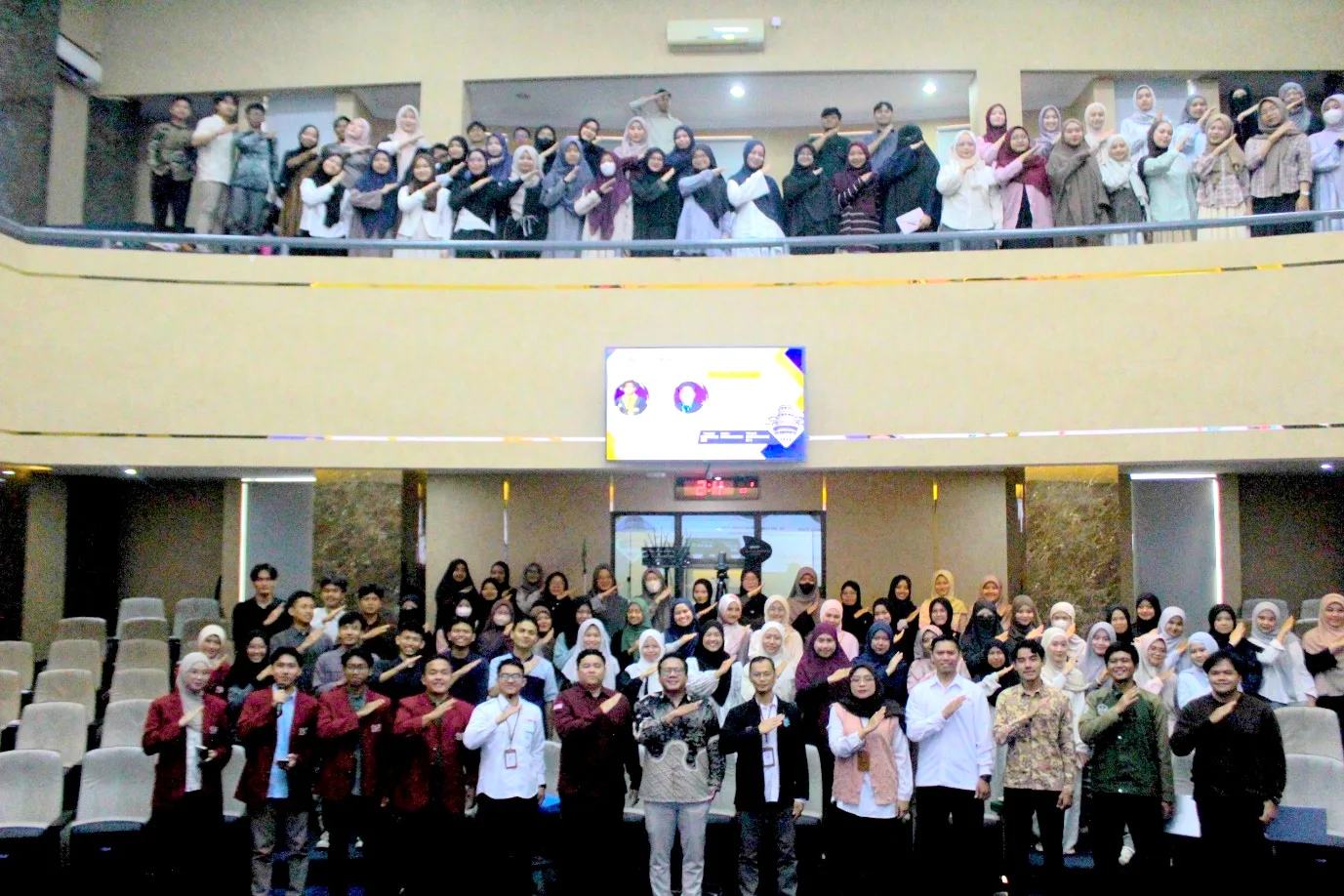
Bandung, September 7, 2026 — The Arabic Language Education Study Program, Faculty of Language and Literature Education (FPBS), Universitas Pendidikan Indonesia (UPI), held a Visiting Lecturer session on Monday (7/9/2026). The activity, which took place from 09.00 to 12.00 WIB, was held at Auditorium B, 4th Floor, FPBS UPI, and was attended by fifth- and seventh-semester students of the Arabic Language Education Study Program.
The event began with an opening session and prayer, followed by remarks from the Head of the Arabic Language Education Study Program, Dr. Asep Sopian, M.Ag. Through this activity, students had the opportunity to broaden their academic insight through presentations by two speakers, Dr. Doni Wahidul Akbar, Lc., S.S., M.Hum. and Dr. Ari Khairurrijal Fahmi, M.Pd.
Dr. Ari Khairurrijal Fahmi, M.Pd. delivered a presentation titled “Translation Learning in the Era of AI Technology.” The material covered basic translation theory, Peter Newmark’s translation methods, translation learning in higher education, learning conditions in the era of artificial intelligence (AI), translation learning strategies, and examples of research findings on translation in higher education.
In his presentation, Dr. Ari emphasized that translation is not merely the transfer of words from the source language to the target language. The material explicitly stated, “The essence of translation: conveying an equivalent message, not merely replacing words one by one.” Amid the development of AI technology, students were also introduced to new pedagogical strategies such as post-editing, prompt engineering, the strengthening of critical and ethical thinking, and digital literacy.
Meanwhile, Dr. Doni Wahidul Akbar delivered a presentation titled “Philology and Linguistics in Arabic Manuscripts: A Critical Study of Manuscripts, Language Structure, and the Formation of Classical Meaning.” The material discussed several pillars of manuscript studies, including philology, codicology, textology, semantics, semiotics, and phonology. In the presentation, philology was directed toward understanding cultural heritage and thought preserved in manuscripts, while textology examined the history of texts, transmission processes, textual variants, as well as textual criticism and interpretation.
The relevance of this study was emphasized through a statement in the material that “Philology reveals the cultural products and thoughts of past human societies preserved in written texts (classical Arabic manuscripts).” This presentation provided students with a perspective on the importance of reading classical Arabic manuscripts critically, not only from linguistic aspects but also from the historical and cultural contexts surrounding them.
This Visiting Lecturer activity served as an academic forum for fifth- and seventh-semester students to connect linguistic studies, classical Arabic manuscripts, translation, and the development of AI technology with academic and professional needs in the field of Arabic Language Education. The presence of these two perspectives also enriched students’ learning experience by bringing together language studies and classical texts with the challenges of language learning in the era of digital transformation.
Through this activity, the Arabic Language Education Study Program of FPBS UPI also strengthened its academic culture and inter-institutional collaboration network among higher education institutions. More broadly, the activity aligns with the Sustainable Development Goals (SDGs), particularly SDG 4 on Quality Education through the strengthening of student learning and academic insight, and SDG 17 on Partnerships for the Goals through the development of cooperation and academic exchange between higher education institutions.