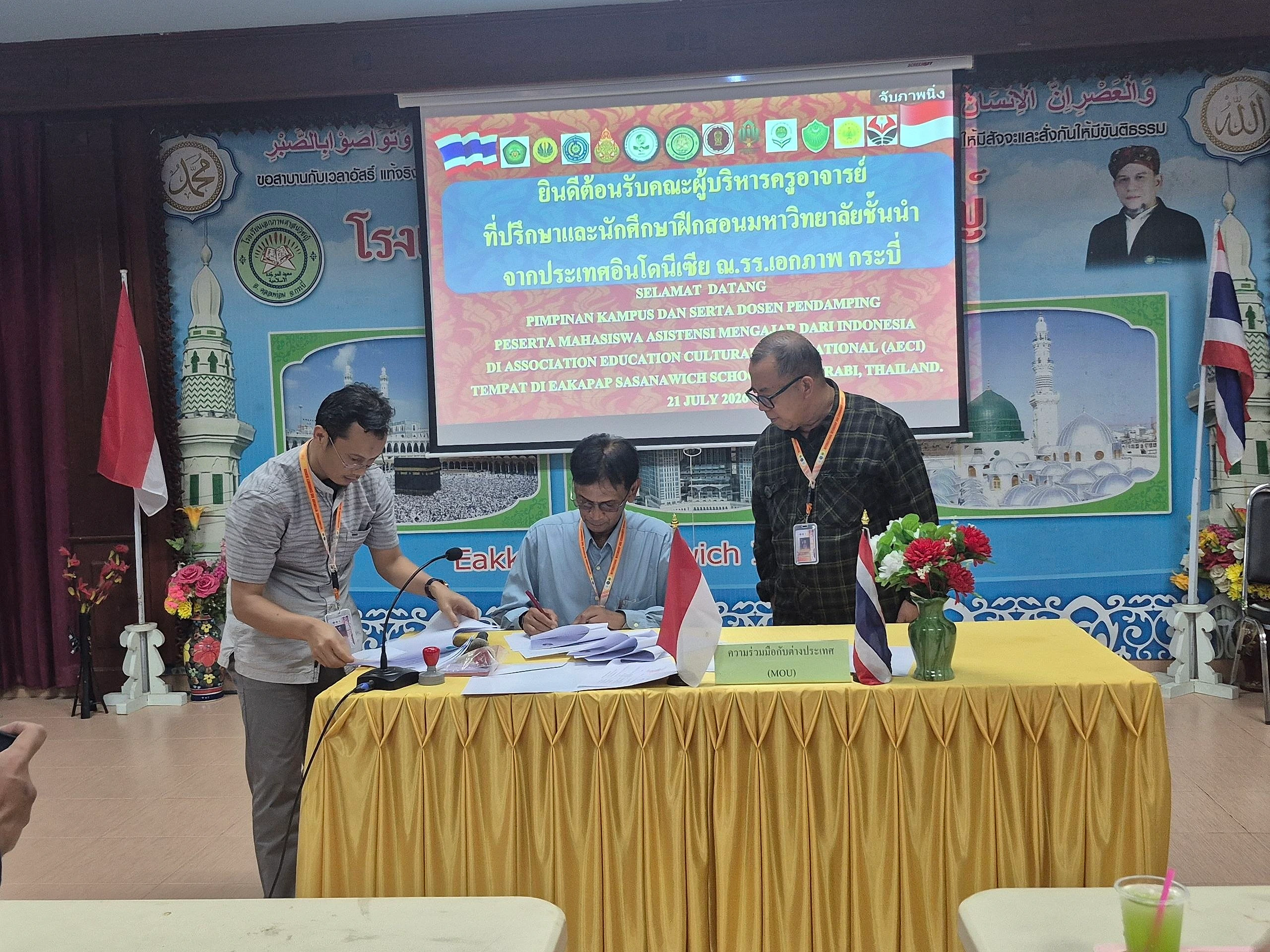
Documentation by PBA FPBS UPI 2026
Krabi, Thailand - The Arabic Language Education Study Program (PBA), Faculty of Language and Literature Education (FPBS), Universitas Pendidikan Indonesia (UPI), recorded another important achievement in its internationalization agenda through an academic cooperation program in Krabi Province, Thailand, on 21-24 July 2026. The activity resulted in the signing of a Memorandum of Agreement (MoA) and Implementation Agreement (IA) with AECI Thailand (Association of Education and Cultural International) and four Islamic schools in Krabi as a foundation for the development of education, research, community service, and human resource capacity building.
The four partner schools in this collaboration are Eakkapap Sasanawich Islamic School, Muslim Wittaya School, Ban Khlong Rua School, and Anuban Muslim Krabi School. The signing of the MoA and IA marks an important milestone in strengthening PBA FPBS UPI’s international collaboration, particularly in Arabic language learning development, collaborative research, teacher training, curriculum development, academic exchange, and reputable international scientific publications.
The PBA FPBS UPI delegation consisted of Prof. Dr. Sofyan Sauri, M.Pd., Dr. Asep Sopian, M.Ag., and Dr. Mia Nurmala, M.Pd. From the partner side, the activity was supported by AECI Thailand (Association of Education and Cultural International), together with school leaders, teachers, and Islamic education practitioners in Krabi Province.
As a follow-up to the signing of the cooperation documents, PBA FPBS UPI carried out an international community service program at Eakkapap Sasanawich Islamic School under the theme “Study of Learning Obstacles and Didactical Intervention in Arabic Learning.” The program was attended by Ust. Ruslan and Arabic language teachers as the main participants.
The community service program was designed to strengthen teachers’ capacity to develop more effective Arabic language instruction through the identification of learning obstacles and the preparation of didactical interventions suited to learners’ characteristics. This approach is expected to improve the quality of Arabic language learning in Islamic schools, particularly in the context of Muslim communities in Thailand.
In his remarks, Prof. Dr. Sofyan Sauri, M.Pd. emphasized that Arabic language learning is not only directed toward linguistic competence, but also serves as a means of character building, strengthening Islamic values, and developing noble character. According to him, teachers play a strategic role in building learning that integrates knowledge, skills, and character values in a comprehensive manner.
In the main session, Dr. Asep Sopian, M.Ag. presented the concept of learning obstacles within the framework of Didactical Design Research (DDR), grounded in the Anthropological Theory of the Didactic (ATD). He explained that before preparing textbooks or designing instruction, teachers need to analyze the learning obstacles experienced by students so that the learning process truly corresponds to their learning needs.
According to him, there are three main forms of learning obstacles: ontogenic, epistemological, and didactical. Ontogenic obstacles relate to learning readiness, cognitive development, and learners’ prior abilities. Epistemological obstacles arise when concepts or materials are presented without considering the developmental sequence of knowledge, making it difficult for learners to build understanding. Didactical obstacles stem from learning design, material presentation strategies, or types of tasks that do not adequately support the learning process.
Dr. Asep stressed that Arabic language textbooks must be able to minimize these three types of obstacles. Materials should be arranged according to students’ learning readiness, developed based on a logical and systematic sequence of concepts, and equipped with activities and tasks that support the process of knowledge construction.
Thus, textbooks should not only serve as sources of information, but also function as didactical tools that facilitate gradual, meaningful, and learner-centered learning.
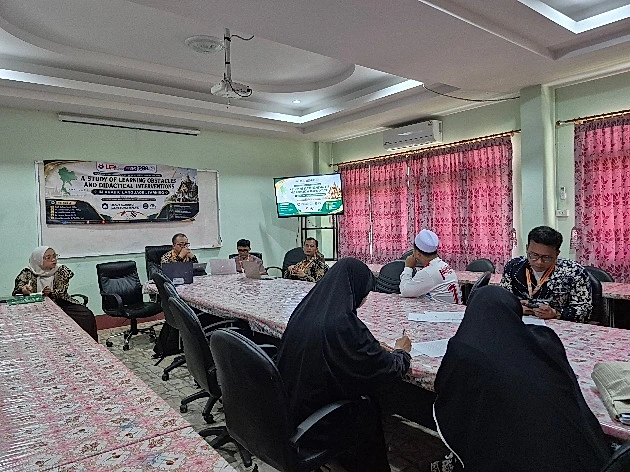
Dr. Mia Nurmala, M.Pd. then delivered a session on strengthening teachers’ professional competence through learning innovation, reflection on teaching practice, and the development of a collaborative learning culture. She emphasized the importance of teachers continuously adapting to curriculum developments and learners’ needs in the era of global education.
In addition to the presentation sessions, the community service program also included group discussions, identification of Arabic learning problems, analysis of teachers’ teaching experiences, and the preparation of learning design recommendations based on the analysis of learning obstacles. Participants responded positively because the introduced approach was considered practical and relevant to the learning conditions in their respective schools.
The series of activities also included a Focus Group Discussion (FGD) on character education based on local wisdom. This forum served as a space for exchanging ideas among PBA FPBS UPI lecturers, AECI Thailand, and educators from partner schools on the development of a character education model that integrates local cultural values with Arabic language learning.
The FGD produced a shared understanding to develop collaborative research on character education based on local wisdom as part of learning innovation in Islamic school environments. The research results are planned to serve as the basis for the development of learning models, international scientific publications, and sustainable community service programs.
The head of the PBA FPBS UPI delegation stated that this cooperation is part of the study program’s commitment to supporting UPI’s internationalization through productive and sustainable partnerships. The signing of the MoA and IA is expected not to stop at the administrative level, but to become a foundation for implementing various concrete programs that benefit both parties.
Through collaboration with AECI Thailand (Association of Education and Cultural International) and four Islamic schools in Krabi, PBA FPBS UPI further strengthens its role as an institution actively building international academic networks. This collaboration is expected to generate various innovations in Arabic language learning, enhance teacher competence, expand reputable international scientific publications, and contribute meaningfully to the development of Islamic education in Indonesia and Thailand.