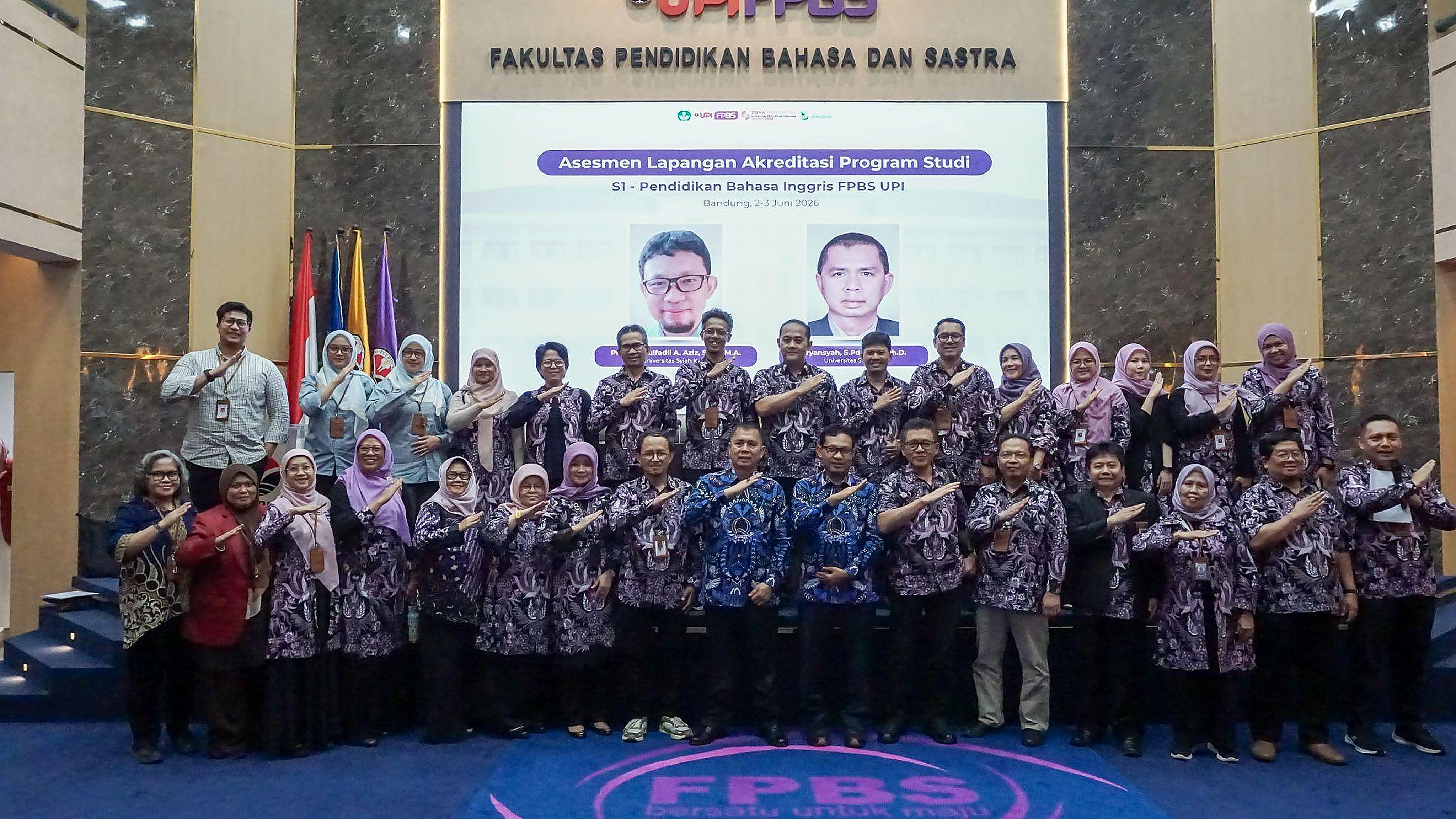
Bandung, 4 June 2026
The Undergraduate English Language Education Study Program of the Faculty of Language and Literature Education (FPBS), Universitas Pendidikan Indonesia (UPI), officially underwent the Site Assessment (Asesmen Lapangan/AL) conducted by the Independent Accreditation Agency for Education (LAMDIK) on Tuesday and Wednesday, 2 and 3 June 2026, at the UPI Bandung campus.
This activity marked a crucial stage in the study program accreditation cycle, during which the assessors directly verified various aspects of educational implementation, ranging from academic governance, lecturer competence, and learning quality to facilities and infrastructure, as well as the involvement of alumni and graduate employers.
“The site assessment is an important moment to demonstrate in concrete terms the study program’s commitment to maintaining and improving the quality of English language education at the national level.”
For two full days, the assessor team, consisting of Prof. Dr. Zulfadli A. Aziz, S.Pd., M.A. (Universitas Syiah Kuala) as Assessor 1 and Eryansyah, S.Pd., M.A., Ph.D. (Universitas Sriwijaya) as Assessor 2, carried out a comprehensive series of assessment sessions.
On the first day, the activity was officially opened with remarks from university leadership, Prof. Dr. Tri Indri Hardini, M.Pd., Vice Rector for Resources and Information Systems, and from the leadership of the study program management unit (UPPS), Prof. Wawan Gunawan, M.Ed., Ph.D., Dean of FPBS. The subsequent agenda included verification sessions with the UPPS leadership, the leadership of the Undergraduate English Language Education Study Program, the internal quality assurance team, permanent lecturers, educational staff, active students, alumni, and graduate employers. The second day focused on learning observation through a microteaching session, inspection of academic support facilities and infrastructure, and the wrap-up and closing session, which included feedback and recommendations from the assessors to the UPPS and study program leadership.
This LAMDIK site assessment is in line with UPI’s vision as a leading and outstanding university (a pioneering and excellent university), which consistently encourages all of its academic units to achieve the highest quality standards. The accreditation process also serves as a concrete manifestation of UPI’s mission to provide quality education that is relevant to the needs of society, while at the same time strengthening accountable and transparent institutional governance.
Furthermore, this quality improvement effort contributes to the achievement of the Sustainable Development Goals (SDGs), particularly SDG 4 (Quality Education) through the assurance of high learning standards, SDG 10 (Reduced Inequalities) through broader access to quality English language education, and SDG 17 (Partnerships for the Goals) through synergy among higher education institutions, accreditation bodies, and stakeholders in national education.