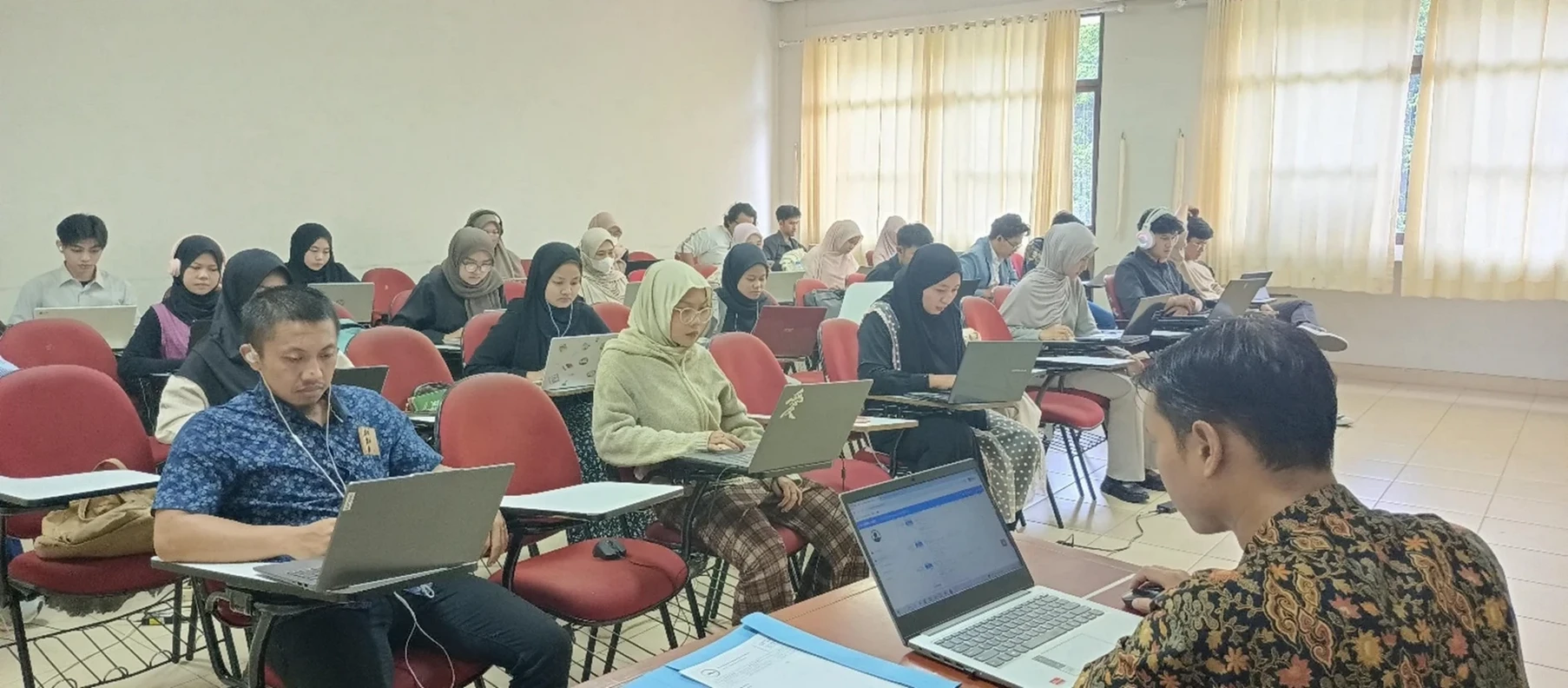
Bandung, July 2025 – The Arabic Language Education Program, Faculty of Language and Literature Education, Universitas Pendidikan Indonesia (UPI), once again conducted the IKHFA (Ikhtibar Kafaah Al-‘Arabiyyah) as a mandatory requirement for final-year students prior to undertaking their undergraduate thesis defense, academic article defense, or master’s thesis examination. The test was held in two waves on June 11 and 25, 2025, in the lecture rooms of the Arabic Language Education Program at FPBS UPI, with each batch limited to a maximum of 30 participants.
The IKHFA is not merely an academic administrative requirement but also plays a strategic role in the implementation of the Sustainable Development Goals (SDGs), particularly Goal 4: Quality Education. By measuring standardized Arabic language proficiency, IKHFA ensures the linguistic competence, critical thinking skills, and global readiness of its graduates in multilingual communities.
Designed to resemble the TOAFL (Test of Arabic as a Foreign Language), the IKHFA test covers three key skills: istima’ (listening), qira’ah (reading), and qawa’id (grammar). Each participant answers 140 multiple-choice questions within approximately two hours using the Safe Exam Browser (SEB) application to maintain exam security and integrity.
The score thresholds are quite rigorous: a minimum of 500 is required for undergraduate students and 550 for postgraduate students. Successful participants receive a digital certificate via an online system, while those who fall short may retake the test in the following period. The test is scheduled regularly twice a month as part of the academic quality assurance mechanism.
Student enthusiasm for the test is notably high, as seen in how quickly the participant quotas filled - just a few days after registration opened through the official link https://s.id/registrasi-ikhfatest. The program office sent technical guidelines via email to each participant, covering software installation and test regulations.
Lecturers and organizing staff directly supervised the exams, ensuring a disciplined and conducive environment. This initiative aligns with UPI’s commitment to developing high-quality human resources capable of competing globally, in accordance with the core mission of SDG 4: “ensuring inclusive and equitable quality education and promoting lifelong learning opportunities for all.”
(Farhan Fuadi)