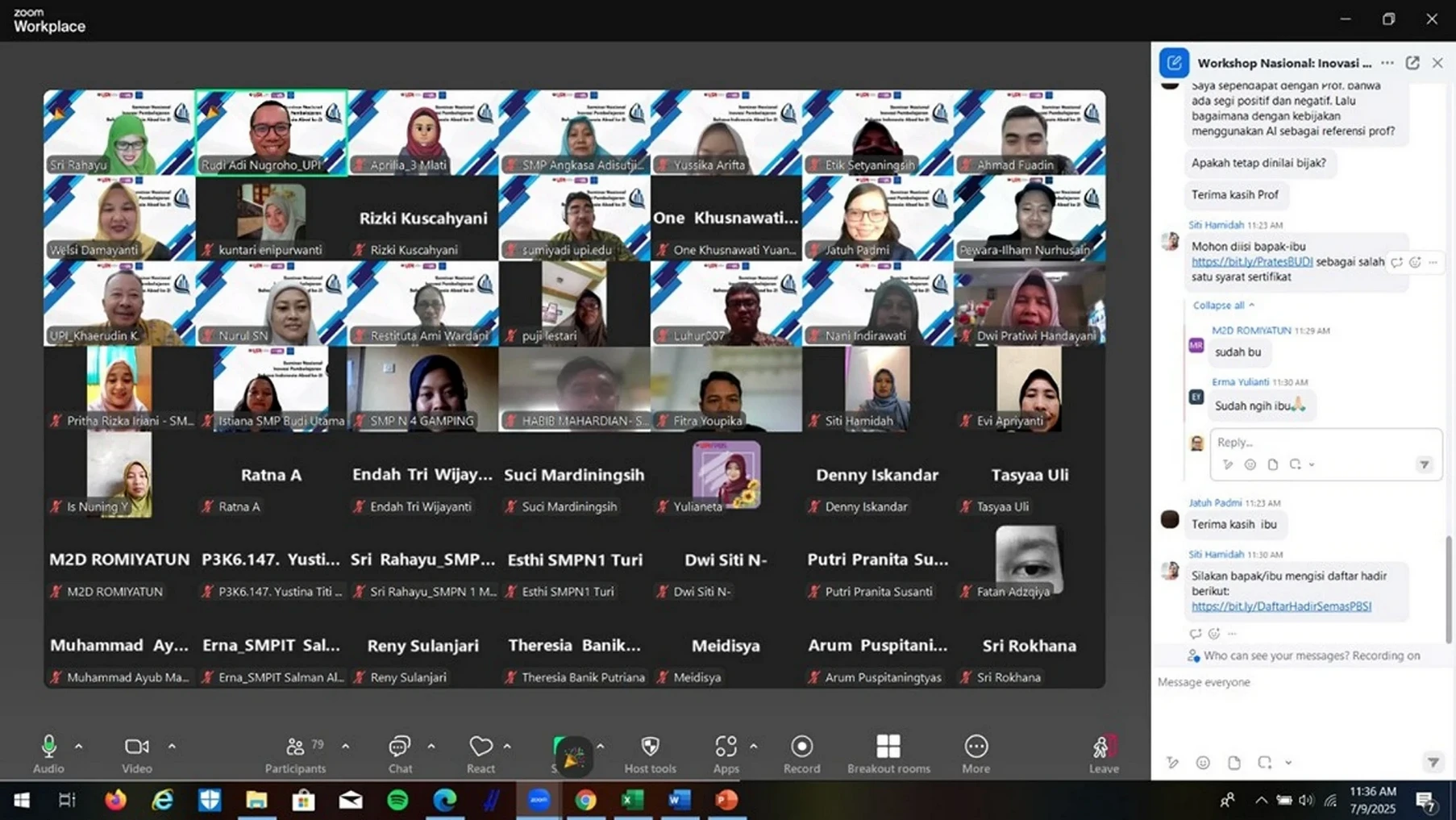
Bandung, July 9, 2025
As part of its active contribution to the Sustainable Development Goals (SDGs) - specifically Goal 4: Quality Education and Goal 17: Partnerships for the Goals - the Indonesian Language and Literature Education Study Program (PBSI) at FPBS UPI, in collaboration with the Indonesian Language MGMP Forum of Sleman Regency, organized a national seminar titled “Innovations in 21st Century Indonesian Language Learning.”
Held online via Zoom Meeting on Wednesday, July 9, 2025, the seminar was attended by teachers, students, and academics. It served as a strategic platform for exchanging ideas, strengthening networks, and building cross-institutional collaboration to address the challenges of Indonesian language education in the digital era.
The speakers invited were experts in the field of Indonesian language education, sharing innovative practices, cutting-edge learning technologies, and contextual pedagogical approaches relevant to 21st-century needs.
In addition to enriching participants’ knowledge, the seminar emphasized the importance of language as an instrument for social transformation and a driver of sustainable literacy. The event directly supported efforts to enhance the professional competence of teachers and educators.
More than just an academic forum, the seminar embodied a shared commitment to advancing the SDG agenda through improved access to quality, inclusive, and relevant education, while fostering strategic partnerships between higher education institutions and regional teaching communities.
“Through collaborations like this, we not only discuss innovation but also bring to life the spirit of mutual cooperation for better education for future generations,” said one of the organizing committee members.
The event is expected to serve as a model for sustainable collaboration between universities and local educational communities, while also reinforcing the role of the Indonesian language as a driver of civilization and sustainable development.
(Ahmad Fuadin)