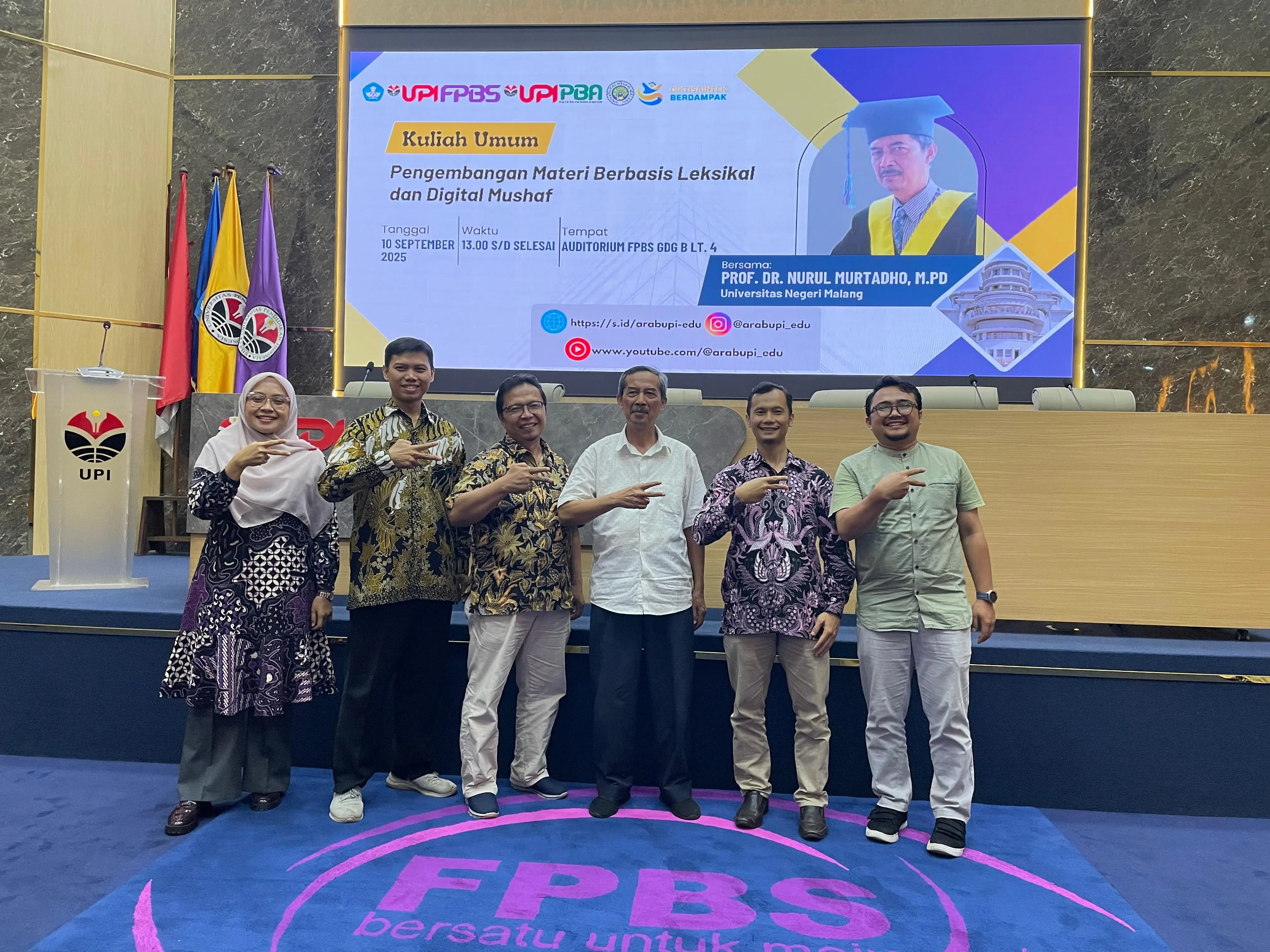
Bandung, September 10, 2025 – Universitas Pendidikan Indonesia (UPI), through the Arabic Language Education Study Program (PBA), reaffirmed its active role in supporting Sustainable Development Goal (SDG) 4: Quality Education. On Wednesday, September 10, 2025, a Public Lecture titled “Development of Lexical-Based Materials and Digital Mushaf” was held at the FPBS Auditorium, Building B, 4th Floor. The event was officially opened by Prof. Dr. Mohamad Zaka Al Farisi, M.Hum., Vice Dean for Resources, Finance, and General Affairs, who also serves as a lecturer in the Arabic Language Education Study Program at FPBS UPI.
In his opening remarks, Prof. Dr. Mohamad Zaka Al Farisi emphasized the urgency of innovation in Arabic language education, particularly in creating inclusive and high-quality access. He stated, “The development of lexical-based teaching materials, which utilize vocabulary in functional contexts, combined with an interactive digital Mushaf, can enrich the learning experience, enhance student motivation, and inspire research efforts to achieve the targets of SDG 4.”
The keynote lecture was delivered by Prof. Dr. Nurul Murthadho, M.Pd. from Universitas Negeri Malang, who highlighted the importance of a lexical-based approach in Arabic language learning. The developed materials focused on language chunks as the main learning units rather than grammatical structures, in line with the 2009 Ministry of Religious Affairs curriculum standards, which set vocabulary targets of 300 words for MI, 450 for MTs, and 750 for MA. Prof. Nurul explained that vocabulary formation is achieved through understanding sentences and definitions so that mufrodat is not only memorized but used communicatively in conversations.
The use of the Madinah Mushaf, adapted to Rasm Uthmani, served as the main reference in interpreting and learning vocabulary authentically. Teaching methods involving word cards with images and descriptive notes improved students’ Arabic language skills in practical and engaging ways. This approach was further supported by digital materials such as interactive applications featuring Qur’anic verses complete with phonetics, translations, vocabulary exercises, and automatic quizzes. These apps also included progress-tracking features that assist teachers/lecturers in tailoring their teaching methods.
This material development model is consistent with SDG 4.a, which promotes inclusive learning facilities, including easy access to interactive digital Mushaf-based materials that can be used by learners of various proficiency levels. The approach not only expands learning reach but also ensures adaptive and responsive environments that cater to individual student needs, including those with limited physical or technological access.
Furthermore, this model aligns with SDG 4’s emphasis on increasing the number and quality of teachers. With learning analytics and progress-tracking features, educators have evaluation tools and professional development support that encourage continuous improvement of teaching methods. This drives teachers to adopt innovative learning materials and effectively use digital technology to ensure high-quality and sustainable education.
Through the development of lexical-based materials and digital Mushaf, UPI continues to strengthen its commitment to providing relevant and contextual quality Arabic language education.