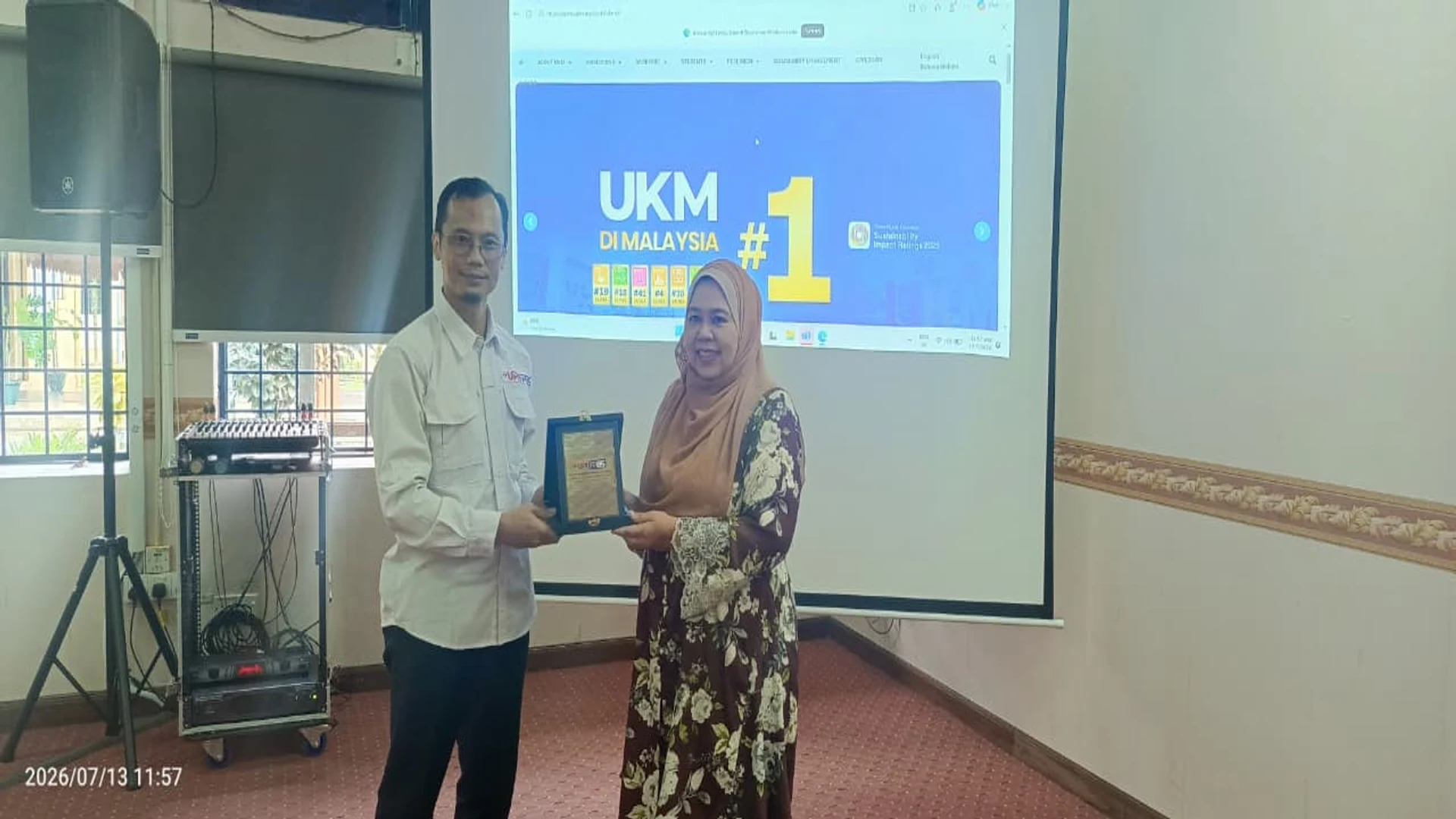
BANGI, Malaysia, July 13, 2026 - The Arabic Language Education Study Programme at the Faculty of Language and Literature Education (FPBS), Universitas Pendidikan Indonesia (UPI), held an international community engagement programme at the Centre for Research in Language and Linguistics, Universiti Kebangsaan Malaysia (UKM), bringing together academics from Indonesia and Malaysia to explore research-based approaches to Arabic textbook evaluation.
The programme, themed “Evaluation of Arabic Language Teaching Materials Based on Didactical Design Research (DDR): A Study in Indonesia and Malaysia,” focused on the application of Didactical Design Research (DDR) and the Anthropological Theory of the Didactic (ATD) in examining the structure and pedagogical foundations of Arabic language teaching materials.
The international programme was attended by five lecturers from UPI’s Arabic Language Education Study Programme, academics from UKM’s Centre for Research in Language and Linguistics, and Arabic language lecturers from UKM’s Faculty of Islamic Studies.
The event was moderated by Associate Professor Dr. Ashinida Aladdin and officially opened by Associate Professor Dr. Mohamed Zain bin Sulaiman. The academic gathering provided a platform for Indonesian and Malaysian scholars to exchange perspectives on current challenges in Arabic language education and the need for more systematic methods of evaluating teaching materials.
A key session was delivered by Professor Dr. Didi Suryadi, M.Ed., who presented a framework entitled “Researching Didactical Design by Applying the Anthropological Theory of the Didactic (ATD).”
In his presentation, Suryadi introduced ATD as a theoretical lens for investigating didactical design beyond the technical aspects of lesson planning. The framework encourages researchers to examine how knowledge is organised, transformed and practised within particular educational and institutional contexts.
The approach places teaching materials within a broader didactical ecosystem involving knowledge, teachers, learners and educational institutions. From this perspective, a textbook is not merely a collection of topics and exercises but also represents a particular organisation of knowledge and learning practices.
The framework offered participants a different way of examining Arabic language textbooks. Rather than limiting evaluation to content coverage, visual presentation or chapter organisation, researchers are encouraged to investigate the underlying didactical structure that shapes learners’ engagement with knowledge.
Building on the theoretical discussion, Dr. Asep Sopian, S.Pd., M.Ag., Head of UPI’s Undergraduate and Master’s Programmes in Arabic Language Education, led a practical session on the application of DDR through praxeology in evaluating Arabic language textbooks in Indonesia.
Sopian demonstrated how praxeological analysis could be used to identify and examine four interrelated components: task (T), technique (τ), technology (θ) and theory (Θ).
Participants were invited to examine the types of tasks presented in Arabic textbooks and identify the techniques expected of learners in completing them. The analysis then moved towards investigating the rationale or explanation supporting those techniques and the theoretical foundations underlying the organisation of knowledge.
The approach, Sopian explained, allows educators and researchers to move beyond conventional textbook assessment. A learning task should not only be judged by its level of difficulty or relevance to a particular language skill. It can also be analysed in terms of how learners are expected to solve it, why a particular technique is used, and what body of knowledge supports the learning process.
The practical demonstration drew strong interest from participants and led to an active question-and-answer session. UKM academics raised questions about the potential application of praxeology to Arabic language teaching materials used in Malaysia, particularly in contexts where Arabic is taught as a foreign or additional language.
Discussions also addressed the relationship between ATD and DDR, the role of praxeology as an analytical tool, and the challenges involved in identifying didactical problems in textbooks.
The exchange became increasingly dynamic as Indonesian and Malaysian academics compared their experiences in Arabic language education. Participants discussed differences in learner backgrounds, curriculum structures, institutional contexts and learning objectives in the two countries.
Despite these differences, the forum highlighted a shared concern: the need to develop Arabic language teaching materials that are academically grounded, responsive to learners’ difficulties and supported by systematic educational research.
The Indonesia-Malaysia context also offers considerable potential for comparative research. Arabic textbooks used in different educational institutions may present different types of tasks, techniques and knowledge structures. Comparative praxeological analysis could therefore help researchers map how Arabic language knowledge is organised and taught across institutions and national contexts.
For UPI’s Arabic Language Education Study Programme, the international community engagement programme reflects a broader commitment to integrating research findings into academic and professional engagement.
The programme also demonstrates how international community engagement can move beyond conventional outreach activities and become a platform for research-based knowledge exchange among university academics.
The meeting at UKM is expected to open further opportunities for joint research, comparative textbook studies, collaborative academic publications and the development of innovative approaches to Arabic language teaching in Indonesia and Malaysia.
Through the integration of DDR, ATD and praxeological analysis, the programme introduced a critical and systematic perspective on Arabic textbook evaluation. More importantly, it strengthened academic dialogue between Indonesian and Malaysian scholars seeking to improve the quality and relevance of Arabic language education.
The Bangi meeting marked another step towards closer academic collaboration between UPI and UKM, with research, knowledge sharing and educational innovation at the centre of their engagement.