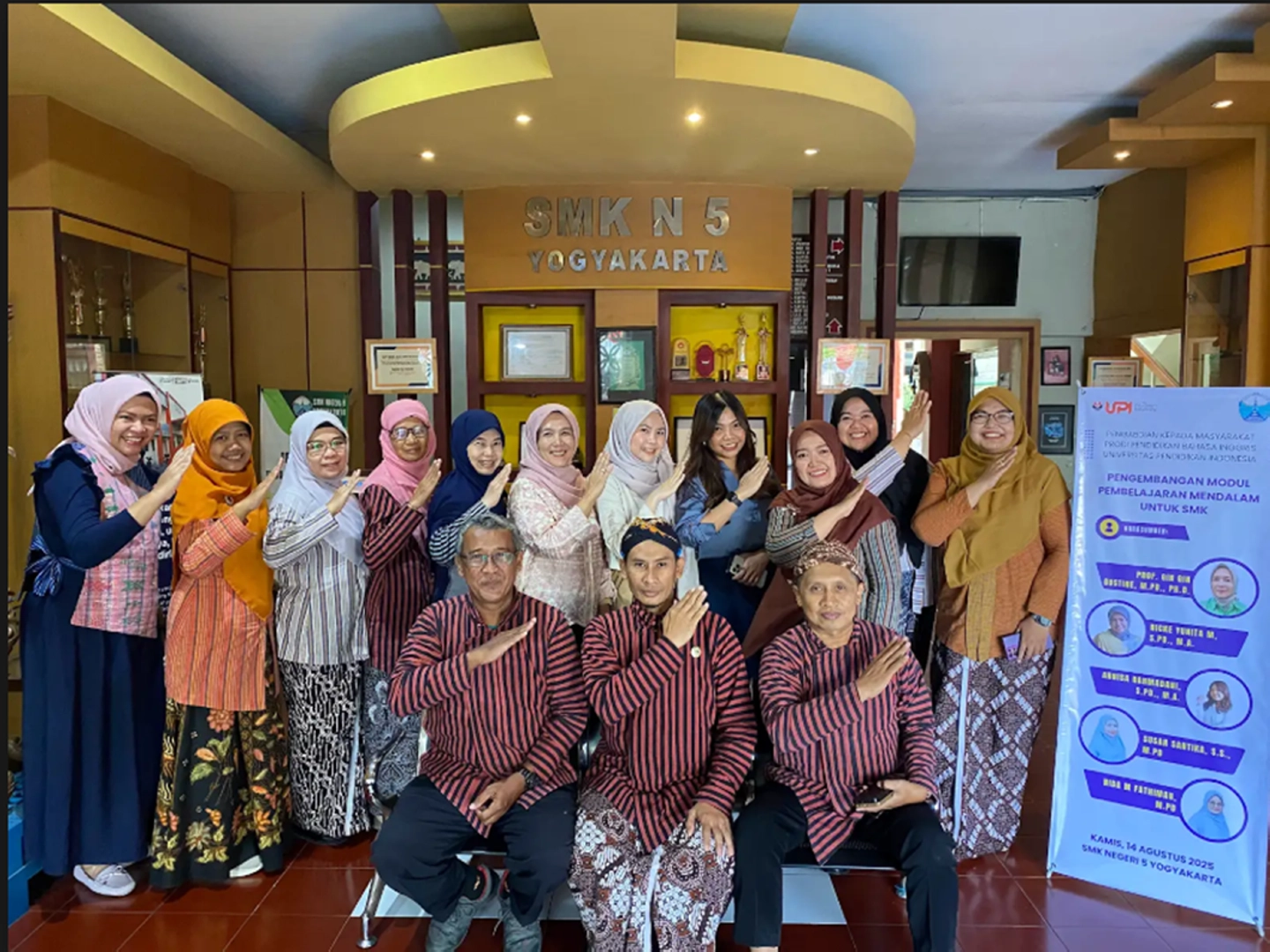
Yogyakarta, August 14, 2025 – The English Education Study Program, FPBS UPI, reaffirmed its commitment to quality education by conducting teacher training with a Deep Learning approach for vocational school (SMK) teachers. This Community Service Program (PKM), held at SMKN 5 Yogyakarta, specifically helped teachers understand students’ learning needs through the principles of meaningful, joyful, and mindful learning – a strategic step to support SDG 4 (Quality Education).
The Principal of SMKN 5 Yogyakarta, Sihono, S.Pd., emphasized the importance of this training in improving teachers’ understanding of vocational students’ learning needs. “Teachers’ understanding of vocational students’ learning needs is crucial. This training helps our teachers design learning that truly fits the context and interests of students,” he said.
Focus on Vocational Students’ Learning Needs
This PKM team from UPI was led by Prof. Gin Gin Gustine, Ph.D., with members Nicke Yunita Moecharam, M.A., Annisa Rahmadani, M.A., Susan Santika, M.Pd., and Nida M. Fathimah, M.Pd. The training began with an online session on July 10, 2025, followed by an offline session at SMKN 5 Yogyakarta. It was designed using a participatory approach:
- Needs analysis by recognizing the characteristics of Gen Z learners
- Designing contextual materials that link learning to the world of work
“This Deep Learning approach helps teachers understand that effective learning must start from a deep understanding of who their students are and what they need,” explained Prof. Gustine.
Concrete Support for SDG 4
This activity specifically supports the targets of SDG 4, particularly:
✔ 4.3 – Quality technical and vocational education
✔ 4.4 – Enhanced skills for decent work
✔ 4.7 – Education for sustainable development
“Through this training, we want to ensure that improving teacher quality will directly impact students’ learning experiences,” added Prof. Gustine.
The participants admitted to gaining new perspectives on understanding students. “The mindful learning techniques taught helped me become more sensitive to the specific learning difficulties faced by vocational students,” said one teacher participant.
The training, attended by 5 English teachers and 7 vocational subject teachers, is expected to serve as a model for replication in other schools, strengthening UPI’s role in realizing inclusive quality education.
Signing of Cooperation Agreement Strengthens Long-Term Commitment
As the highlight of the program, a Cooperation Agreement (PKS) was signed between SMKN 5 Yogyakarta and FPBS UPI, represented by Principal Sihono, S.Pd. and Prof. Gin Gin Gustine, Ph.D. The agreement includes:
- Ongoing teacher training and mentoring programs
- Development of teaching materials aligned with labor market needs
- Collaborative research on English learning in vocational schools
With this agreement signed, both institutions are committed to regularly evaluating and developing programs that truly impact learning quality, while serving as a model of strategic higher education–vocational school partnership in Indonesia.