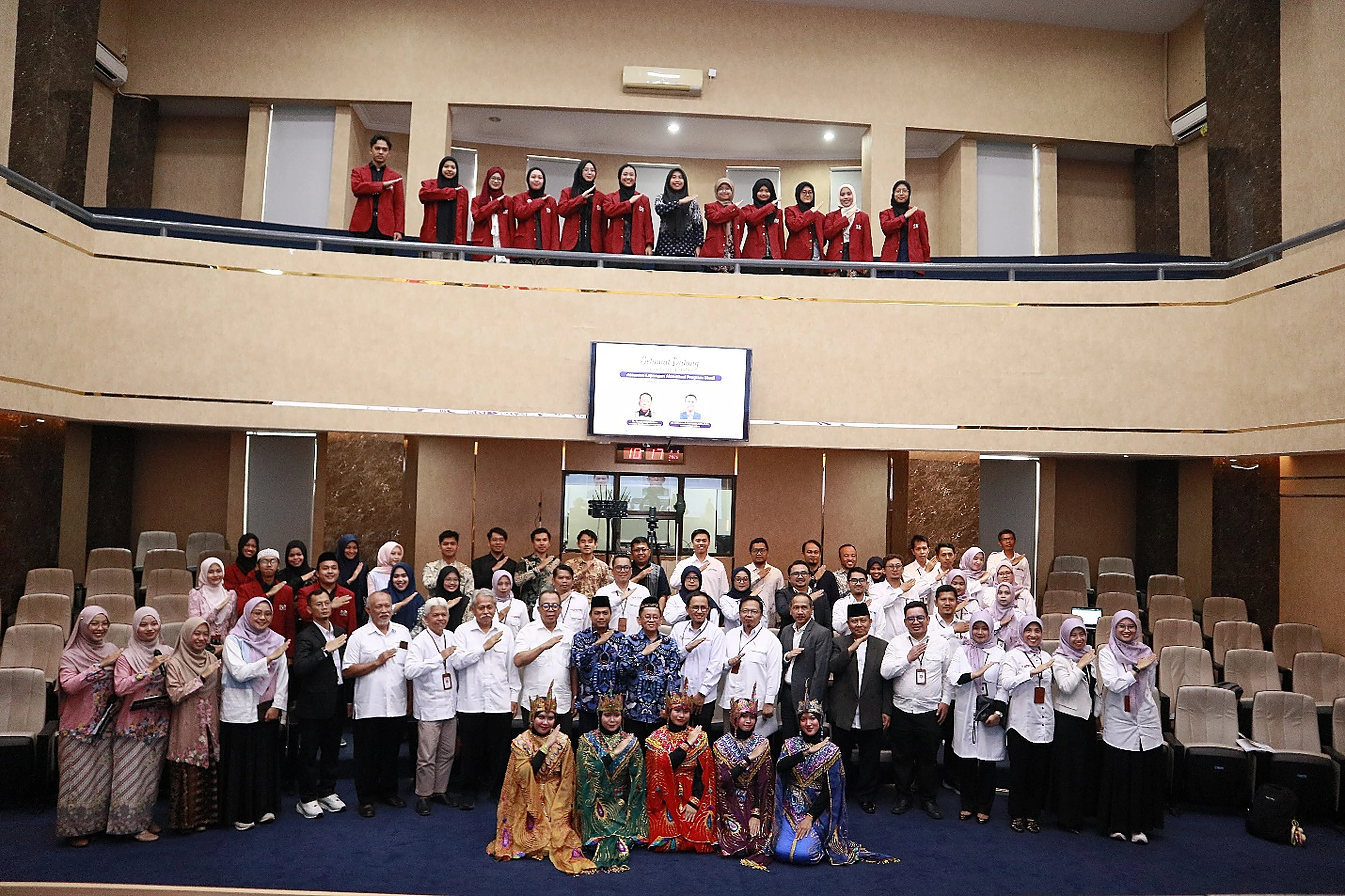
Bandung, 9 June 2026 - The Arabic Language Education Study Program (PBA) of the Faculty of Language and Literature Education (FPBS), Universitas Pendidikan Indonesia (UPI), carried out the LAMDIK Accreditation Site Assessment (Asesmen Lapangan/AL) on 8-9 June 2026. This activity formed an important part of the quality assurance process while also serving as an evaluation of the implementation of the tridharma of higher education within the Arabic Language Education Study Program at FPBS UPI.
The assessor team assigned to this assessment consisted of Dr. Ahmad Royani, M.Hum. from Universitas Islam Negeri Syarif Hidayatullah Jakarta as Assessor 1 and Dr. Mohammad Ahsanuddin, S.Pd., M.Pd. from Universitas Negeri Malang as Assessor 2. The assessors were welcomed by university leaders, faculty leaders, and the PBA UPI academic community.
The opening of the assessment, held at the FPBS UPI Auditorium, began with the recitation of verses from the Holy Qur’an and the singing of Indonesia Raya. Prof. Wawan Gunawan, M.Ed., Ph.D., Dean of FPBS UPI, then delivered opening remarks while presenting the faculty profile and the development of the Arabic Language Education Study Program.
The activity also featured the screening of a faculty and study program profile video presenting various academic and student achievements, as well as the program’s contributions to the development of Arabic language education in Indonesia. This was followed by a presentation of the study program’s achievements and innovations in learning, research, community service, student affairs, and cooperation by the Head of the Arabic Language Education Study Program, Dr. Asep Sopian, M.Ag., accompanied by the Program Secretary, Dr. Rinaldi Supriadi, M.Pd.
The opening session became even more vibrant with a Merak Dance performance presented by PBA students as a form of appreciation for local culture and a representation of the multicultural spirit fostered within the study program.
During the two-day assessment, the assessor team conducted document verification, interviews with lecturers, educational staff, students, alumni, and graduate employers, as well as learning observations and an inspection of facilities and infrastructure. The purpose of these activities was to ensure the alignment between the data presented in the accreditation documents and the actual conditions in the field.
At the closing session, the assessors expressed appreciation for the various good practices that have been developed by the Arabic Language Education Study Program at FPBS UPI. In delivering feedback, Dr. Mohammad Ahsanuddin, S.Pd., M.Pd. emphasized that a site assessment is not a process for finding faults or judging a study program.
“This Site Assessment is not an activity intended to look for shortcomings; we are not judges here to pass judgment. Rather, this AL is a process of confirmation, clarification, and the strengthening of a quality culture. It is possible that the best practices already implemented at PBA UPI can be applied at our campus, or vice versa. Because we share the same goal, namely to advance Arabic language education and learning in Indonesia together,” he said.
He also expressed hope that the various good practices implemented by the PBA UPI Study Program would continue to grow into a sustainable quality culture and create a tangible impact for the academic community and society. In line with the spirit of impactful higher education, this assessment forms part of efforts to improve inclusive and sustainable higher education quality as reflected in Sustainable Development Goal (SDG) 4 (Quality Education). In addition, collaboration among higher education institutions through the accreditation process and the sharing of good practices also supports SDG 17 (Partnerships for the Goals) in building strategic partnerships for the advancement of Arabic language education in Indonesia.